
On this page
Why aluminum is the usual choice
Aluminum is the material on most new gutters in Louisville because it balances cost, durability and appearance:
- It does not rust. Louisville's humid summers and wet springs are hard on steel; aluminum shrugs them off.
- It is light. Easier on fascia and hangers than steel or copper.
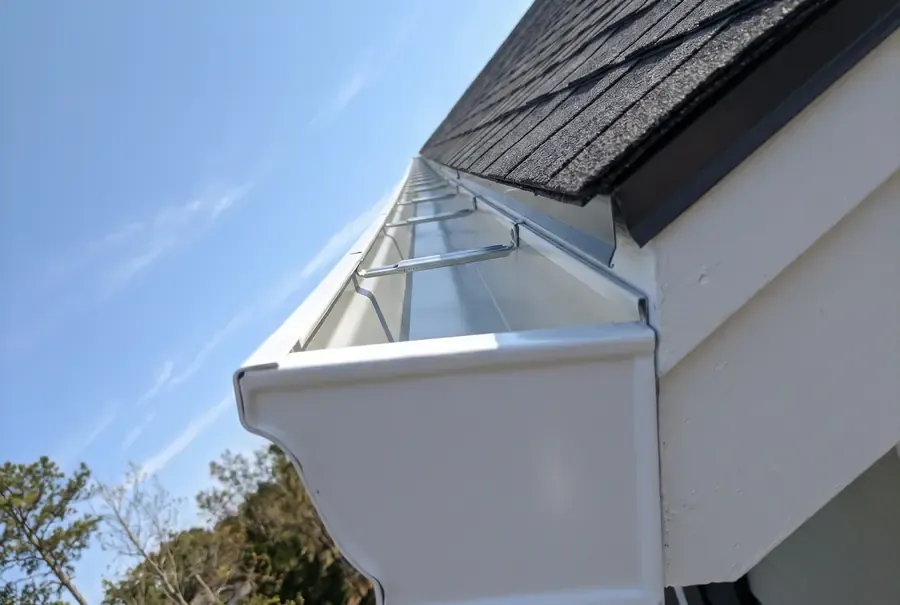
- It forms seamless. Coil runs through a machine on site and comes out the length of the eave.
- It comes in many colors. White, almond, clay, dark bronze, black and many more, with a baked finish.
- It is affordable. National guides put it at about $9 to $13 a foot installed.
Coil thickness
Not all aluminum gutters are the same. The coil comes in different thicknesses, and the difference matters under trees and in storms.
| Coil thickness | Typical use | Notes |
|---|---|---|
| .019–.025 inch | Budget and DIY sectional | Dents easily; not recommended for most houses |
| .027 inch | Common residential standard | Fine on many houses with few trees |
| .032 inch | Heavier residential | Resists dents from limbs, hail and ladders |
Louisville's older neighborhoods sit under big trees, and storms bring them down. The September 2008 windstorm from the remnants of Hurricane Ike caused a great deal of tree damage across the city, and the January 2009 ice storm brought down branches across the region. Heavier coil will not survive a falling oak limb, but it shrugs off smaller branches, hail and ladders far better than thin coil.
Aluminum vs steel vs copper
| Aluminum | Steel | Copper | |
|---|---|---|---|
| Rust | No | Yes, once the coating is scratched | No; develops a patina |
| Weight | Light | Heavy | Moderate |
| Dent resistance | Fair to good, depending on coil | Very good | Good |
| Colors | Many | Several | Natural copper only |
| National cost | About $9 to $13 a foot | About $8 to $13 | About $15 to $40 |
See aluminum vs steel vs copper for a fuller comparison.
Colors for Louisville houses
Louisville's housing ranges from red-brick shotgun houses in Germantown and Portland to Victorian brick and stone in Old Louisville, and vinyl-sided ranches and two-storey houses in the suburbs. Common pairings:
- White with white trim and vinyl siding.
- Dark bronze or musket brown with red brick and limestone.
- Black with painted brick, dark siding and modern trim.
- Almond or clay with beige or tan siding.
Most people match the fascia or trim so the gutter disappears into the roof line.
Things to watch with aluminum
- Contact with copper or treated wood. Aluminum corrodes where it touches copper flashing or pressure-treated lumber; a separator is needed.
- Thin coil. Cheap gutters in very thin coil dent and sag.
- Spikes instead of hangers. Old-style spike and ferrule fastening works loose over time; hidden hangers screwed into solid wood hold far better.
- Expansion. Long runs move with temperature; well-placed outlets and proper fastening allow for it.
A worked example
Here is an illustration, not a quote. A two-storey house in St. Matthews with 160 feet of eave sits under two large oaks. The owner compares .027 and .032 coil. At the national installed range of about $9 to $13 a foot, the gutters come to roughly $1,440 to $2,080 before downspouts, and the heavier coil usually adds a modest amount on top. Given the trees, the heavier coil is the better buy: it resists dents from falling twigs and ladders during cleaning.
Aluminum and Louisville weather
Aluminum does not rust, which matters in a city with about 48.3 inches of precipitation a year and humid summers. Its weak points are denting and expansion. Heavier coil handles the first. The second is handled by fastening: hidden hangers that let the gutter move slightly with temperature, and outlets placed so long runs are not pinned at both ends.