
On this page
Why choose copper gutters?
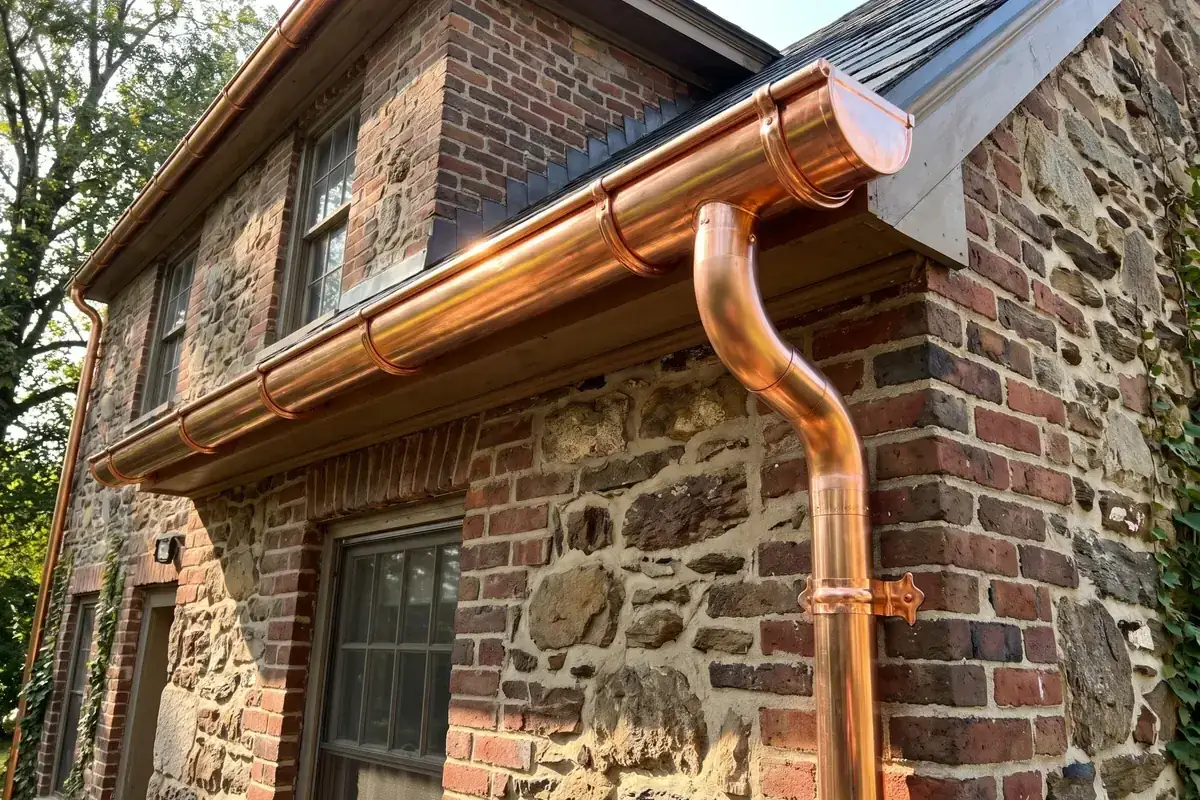
Copper is the premium gutter material. It does not rust, it is strong, its joints are soldered rather than caulked, and it ages to a patina that suits older houses. It costs several times what aluminum does, so it is usually chosen for houses where appearance and longevity matter most.
Where copper suits Louisville houses
Louisville has a deep stock of older houses where copper looks at home:
- Old Louisville, claimed to be the largest preservation district of mostly Victorian architecture in the country, with Queen Anne, Romanesque Revival and Chateauesque houses, many in brick trimmed with red sandstone.
- Cherokee Triangle, an 1880s streetcar suburb with large homes in an eclectic mix of styles.
- Clifton, where the historic district includes Italianate, Queen Anne and Classical Revival architecture.
- Crescent Hill, with a historic district listed for Colonial Revival and Classical Revival architecture.
- Stone and brick houses in the eastern suburbs and the river towns, and churches across the city.
Copper profiles
| Profile | Look | Notes |
|---|---|---|
| Half-round | Traditional, rounded | Most common for historic copper; hung on round brackets |
| K-style | Flat back, ogee front | Same shape as aluminum, in copper |
| Box or built-in | Hidden in the cornice | Relined in copper on some older houses |
| Round downspouts | Smooth cylinders | Usual partner for half-round |
| Conductor heads | Decorative collector boxes | Used on churches and grand houses |
What copper costs
National guides put copper gutters at about $15 to $40 a foot installed, against about $9 to $13 for seamless aluminum. The range is wide because copper weight (often 16 oz or 20 oz per square foot), profile, soldering, brackets and height all vary. A large Victorian with tall eaves, ornate corners and conductor heads sits at the top of the range.
How copper gutters are installed
- Soldered joints. Corners and seams are soldered, not just sealed, for a joint that lasts as long as the metal.
- Copper or compatible fasteners. Brackets, straps and screws must be copper, brass or stainless. Steel and aluminum corrode against copper.
- Expansion joints. Long runs need expansion joints so the metal can move with temperature.
- Compatible flashing. Drip edge and flashing that the gutter touches must be copper or another compatible metal.
- Round downspouts and conductors. Usually copper too, fastened with copper straps.
Copper and Louisville weather
Copper's strength helps under trees and in storms. Louisville has had serious wind and ice events, including the September 2008 windstorm and the January 2009 ice storm, and copper on solid brackets holds up better to limbs and ice weight than thin aluminum. In heavy rain, the main question is still size: a half-round copper gutter needs the right width and enough downspouts for the roof, especially under Louisville's intense summer storms.
Historic districts
Louisville has several preservation districts, including Cherokee Triangle, and many neighborhoods with National Register listings. Copper or half-round gutters are often the right choice there, and visible exterior changes in a local preservation district may need review. Check with Louisville Metro before work begins.
A worked example
Here is an illustration, not a quote. A stone house in Anchorage has 130 feet of eave and the owners want copper half-round. At the national range of about $15 to $40 a foot, the gutters alone could run roughly $1,950 to $5,200, with round downspouts, soldered corners and copper brackets on top. A tall Victorian with conductor heads would sit at the high end.
Looking after copper
Copper needs little care beyond cleaning. Keep leaves out of the trough, check soldered joints when you clean, and keep other metals from touching it. If a joint does start to leak, it is resoldered rather than sealed.
Related pages
- Half-round gutters
- Aluminum vs steel vs copper
- Gutter replacement on older houses
- Commercial gutters for churches and historic buildings