
On this page
Side by side
| Aluminum | Steel | Copper | |
|---|---|---|---|
| National installed cost | About $9 to $13 a foot | About $8 to $13 a foot | About $15 to $40 a foot |
| Rust | Does not rust | Rusts once coating is scratched | Does not rust; patinas |
| Dent resistance | Fair to good, depending on coil | Very good | Good |
| Weight | Light | Heavy | Moderate |
| Seamless on site | Yes | Some contractors | Some contractors |
| Colors | Many | Several | Natural copper |
| Joints | Sealed | Sealed | Soldered |
| Lifespan | Around 20 years or more | Varies with coating | Many decades |
Aluminum
Aluminum is the default for a reason. It does not rust, it is light enough to be easy on fascia, it forms seamless on site, and it comes in dozens of baked-on colors. The thing to ask about is coil thickness. Thin coil dents under a ladder or a falling branch; .032-inch coil is much tougher. In neighborhoods under big trees, the extra cost is worth it. See aluminum gutters.
Steel
Steel, usually galvanized or Galvalume with a painted finish, is stronger than aluminum and resists dents from limbs and hail. Its weakness is rust: once the coating is scratched, by a ladder, a branch or a cleaning tool, rust starts and spreads. In Louisville's humid summers and wet springs, steel needs its coating kept intact. Steel is also heavier, so hangers and fascia need to be sound.
Copper
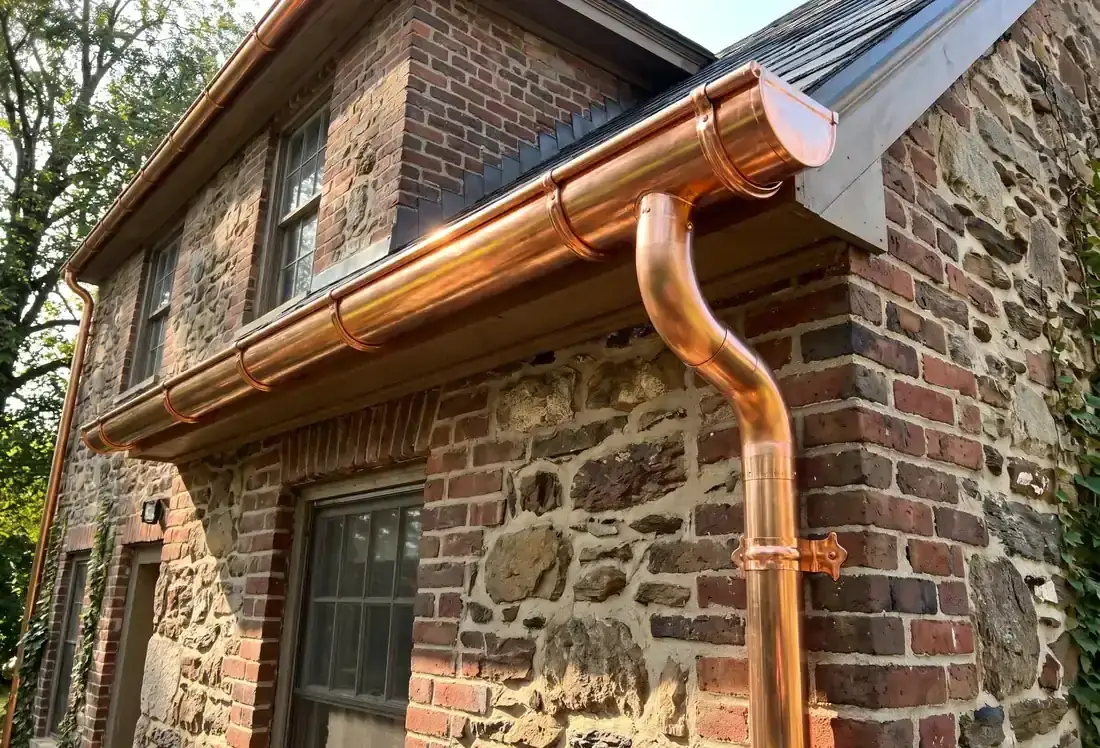
Copper lasts for many decades, its joints are soldered for a lasting seal, and it weathers to brown and then green. It costs several times more than aluminum, so it is usually reserved for houses where looks and longevity justify it. Louisville has many such houses: Old Louisville, with Queen Anne, Romanesque Revival and Chateauesque architecture; Cherokee Triangle; Clifton; and historic churches and stone houses across the city. See copper gutters.
Matching material to the house
| House | Usual choice |
|---|---|
| Vinyl-sided ranch or split-level | Seamless aluminum, 5-inch |
| Two-storey suburban house | Seamless aluminum, 6-inch, heavier coil |
| House under big trees | Heavier aluminum coil or steel |
| Brick shotgun or cottage | Aluminum in bronze or brown |
| Victorian, Tudor or stone house | Copper or aluminum half-round |
| Church or historic commercial building | Copper, or heavy box gutters |
Louisville factors
Trees and storms. Louisville's canopy, about 37 percent of the county in a 2015 assessment, and storms like the September 2008 windstorm mean many gutters take hits from limbs. Heavier aluminum, steel and copper all handle that better than thin aluminum.
Rain. With about 48.3 inches of precipitation a year, gutters run full often. Material matters less here than size and joints; seamless aluminum and soldered copper both minimize leaks.
Ice. Louisville's ice storms, such as the January 2009 storm, load gutters with weight. Close-spaced hangers matter more than the metal.
Do not mix copper with other metals
Copper and aluminum, or copper and steel, corrode where they touch in the presence of water. If copper gutters are installed, flashing, fasteners and brackets must be copper, brass or stainless steel. Water running off a copper roof feature onto aluminum gutters causes the same problem.
A worked example
Here is an illustration, not a quote. A 150-foot job priced at the national ranges would come to roughly $1,350 to $1,950 in seamless aluminum, $1,200 to $1,950 in steel, and $2,250 to $6,000 in copper, before downspouts, removal and wood repair. For most houses, aluminum in heavier coil gives the best balance. Copper makes sense where the house's style and the owners' plans justify it.
What about painted steel on older houses?
Some older Louisville houses still have galvanized or painted steel gutters, often installed decades ago. Where the coating is intact, they can keep working, but once rust starts at a seam or a scratch, it spreads. Replacing them with seamless aluminum in a matching color is the usual route, or copper where the house suits it.