
On this page
Why Louisville gutters overflow
Louisville gets a lot of rain, and it often comes fast. The airport averages about 48.3 inches of precipitation a year, with spring the wettest season and May the wettest month. The extreme end of the range is very wet indeed. On the morning of August 4, 2009, more than 7 inches fell in two to three hours, rain rates reached 8.8 inches an hour, and the National Weather Service issued its first-ever Flash Flood Emergency for Louisville. The Midwestern Regional Climate Center recorded 5 inches in 90 minutes that morning.
No residential gutter is designed for rain like that, but everyday summer thunderstorms still bring bursts that find every weak point in the system.
The usual causes
| Cause | What you see | Fix |
|---|---|---|
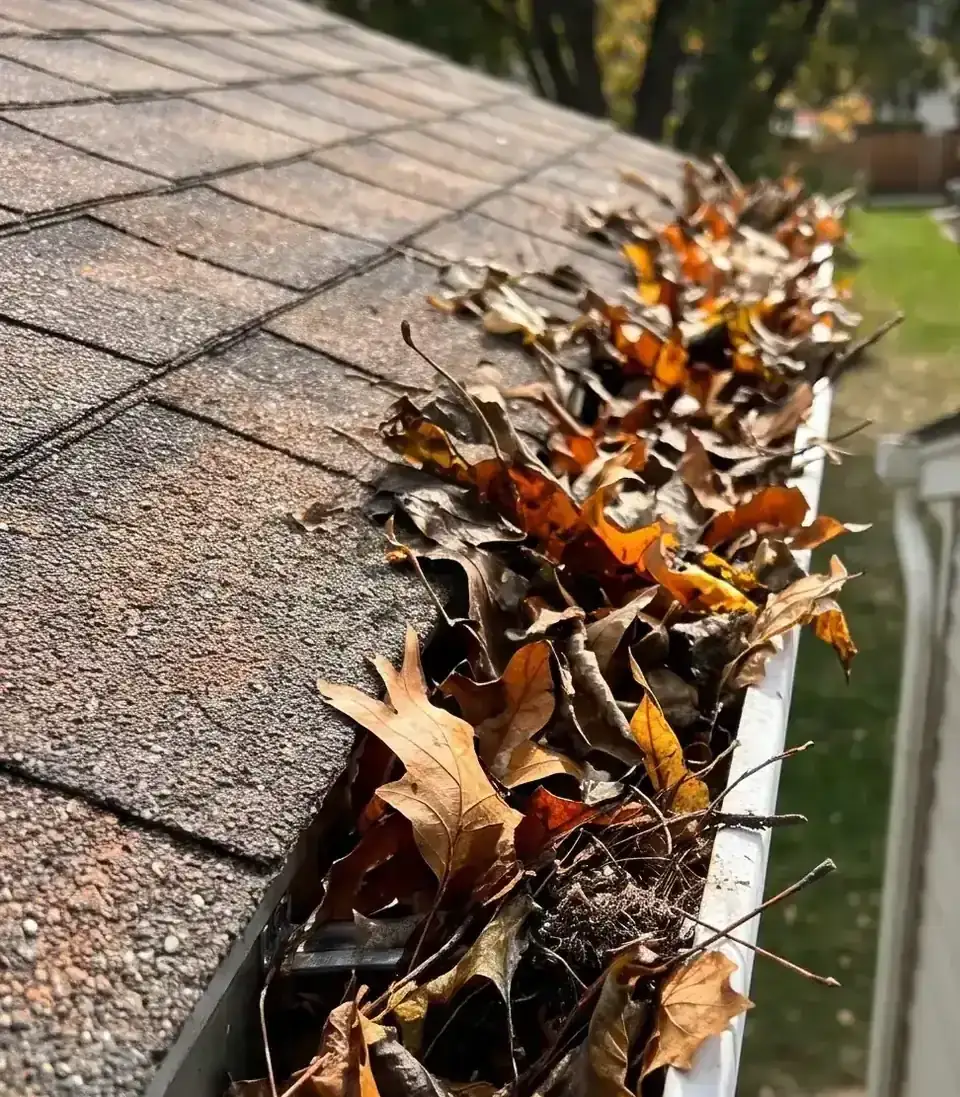
| Blocked outlet | Overflow near the downspout, water standing in the gutter | Clear the outlet and downspout; consider guards |
| Lost pitch | Water standing along the run, overflow at the low spot | Re-hang to an even fall |
| Valley concentration | Overflow at one point below where two roofs meet | Extra outlet near the valley, or a valley splash guard |
| Undersized gutter | Overflow along the whole run when clean | 6-inch gutters |
| Undersized or too few downspouts | Gutter backs up even though the outlet is clear | 3x4 downspouts or more outlets |
| Upper roof draining onto lower roof | Lower gutter overflows below the downspout | Extend the upper downspout to the lower gutter's outlet, or upsize |
| Gutter hung too low | Water overshoots or runs behind | Re-hang under the drip edge |
How a contractor diagnoses overflow
- Ask when it happens. Every rain, only in thunderstorms, or only in spring after the seeds drop.
- Look at the roof. Plane sizes, pitch, valleys, and upper roofs that drain onto lower ones.
- Check outlets and downspouts. Clear them and flush with a hose.
- Check pitch. A level or string line along each run.
- Recommend the fix. Clean and re-pitch, add outlets, add a valley guard, upsize the gutter, or a combination.
Adding outlets vs upsizing
Adding a downspout is often the cheapest fix. A long run with one outlet at the end carries water a long way; an outlet at each end halves that. Where a valley dumps water near a corner, an outlet close to the valley stops the corner overflowing.
Upsizing makes sense when the whole roof overflows. Moving from 5-inch to 6-inch gutters and from 2x3 to 3x4 downspouts gives much more capacity and a larger outlet that is harder for leaves to block. National guides put the difference at about 50 cents to $1 a foot. If the gutters are old or sectional, it is usually worth upsizing at replacement.
Where the water goes next
Fixing overflow moves more water through the downspouts, so check where they discharge. A downspout that dumps a summer storm's worth of water at the foundation can soak the basement wall just as badly as overflow did. Extend it onto ground that slopes away. In the older parts of Louisville, avoid routing it into the combined sewer, which can overflow with as little as a tenth of an inch of rain; MSD pays $100 per downspout to redirect them. See downspouts.
Guards and overflow
Guards prevent the most common cause of overflow, a blocked outlet. But they do not add capacity, and in intense rain some water can sheet over a reverse-curve guard or a mesh coated with pollen. A clean, well-fitted micro-mesh on a properly sized gutter works best. See gutter guards.