
On this page
What downspouts do
The gutter collects the water; the downspout delivers it. A good downspout layout puts outlets where the water collects, carries it down the wall without leaking, and discharges it far enough from the house that it does not soak into the soil against the foundation. Most wet basements that people blame on gutters are really downspout problems.
Downspout sizes
| Size | Pairs with | Notes |
|---|---|---|
| 2x3 inch | 5-inch gutters | Standard on many houses; clogs more easily |
| 3x4 inch | 6-inch gutters, or 5-inch with a big roof | Carries far more water, passes leaves and seeds |
| 3- or 4-inch round | Half-round gutters | Traditional look on older houses |
| 4x5 inch and larger | Commercial roofs | Used on large and flat roofs |
On Louisville's heavier storms, the downspout is often the bottleneck. On August 4, 2009, rain fell at rates up to 8.8 inches an hour. Ordinary summer storms are far gentler, but a 2x3 downspout under a large roof plane can still back the gutter up in a hard burst.
Where the water should go
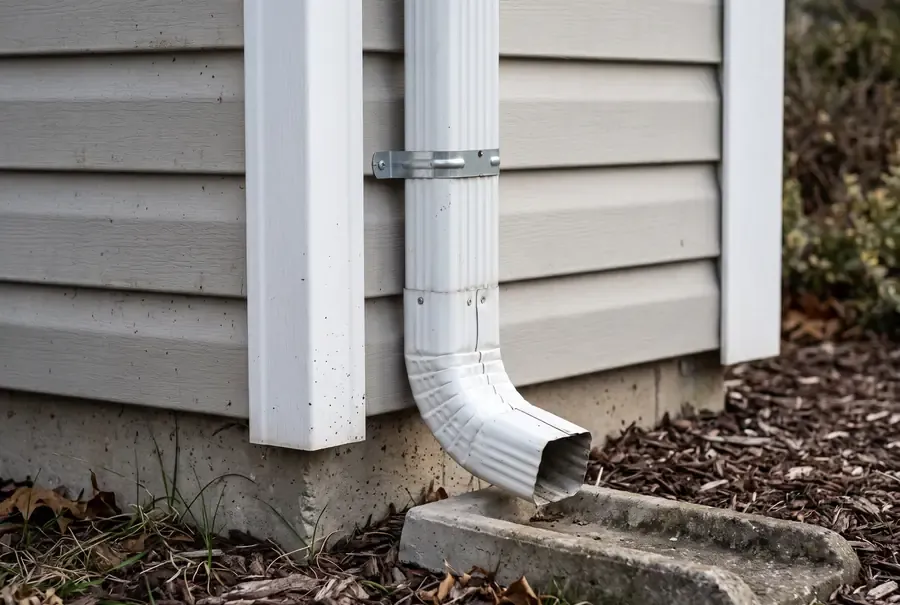
- Extensions. A section of downspout or a flexible extender carrying water several feet from the wall.
- Splash blocks. Concrete or plastic pads that spread the water and stop it digging a hole.
- Buried lines. Pipe that carries water underground to a daylight outlet, a rain garden or a dry well, with the right slope and a clean-out.
- Rain barrels. Useful for garden water, with an overflow that still discharges away from the house.
- Rain gardens. Planted low areas that let roof water soak in away from the foundation.
What matters is that the ground slopes away from the house and the water does not end up against your foundation, your neighbor's house or a sidewalk where it will freeze.
Downspouts and Louisville's combined sewer
In the older parts of Louisville, rainwater and wastewater share one combined sewer. That system can overflow with as little as a tenth of an inch of rain, sending combined rainwater and sewage into the Ohio River and Beargrass Creek. Before MSD's 2005 consent decree, more than 5 billion gallons overflowed each year. MSD has since built storage including the four-mile Waterway Protection Tunnel, which holds 55 million gallons.
Downspouts tied into the ground in those areas add roof water to the load. MSD's Downspout Disconnection Program offers $100 per downspout to redirect them onto the yard or into a rain garden. The key rule: arrange MSD's inspection before any work starts, or the work may not qualify. Call MSD on (502) 540-6000. See downspouts and combined sewers.
MSD also notes that sump pumps connected to the sanitary sewer are not allowed. If you are redirecting downspouts, check where the sump pump discharges too.
Signs your downspouts need work
- Puddles or erosion at the base of a downspout.
- A damp or wet basement wall near a downspout.
- Water pouring out of a joint halfway down the wall.
- A downspout crushed by a mower, car or ladder.
- Water backing up out of a buried line in heavy rain.
- A downspout that empties onto a walkway or driveway that ices over.
See downspout repair for fixes.
A worked example
Here is an illustration. A brick house in an older part of Louisville has three downspouts that run into pipes in the ground, and the basement is damp after storms. The owner calls MSD on (502) 540-6000 to arrange the inspection first. MSD confirms two are connected to the sewer. Once that is done, the contractor cuts both above the ground, caps the pipes, and adds elbows and extensions that carry water onto the lawn on the downhill side. The third, which drains to a working daylight outlet, is flushed and left in place. MSD's program offers $100 per downspout for the disconnected pair.
Related pages
- Downspout repair
- Downspout drainage and your foundation
- 6-inch gutters and 3x4 downspouts
- Gutter installation